
A practical guide for residents on understanding and preventing damp and mould in the home or work environment.
What Causes Damp and Mould?
Damp and mould are closely related but they are not the same thing. Damp is unwanted moisture in a building.
Mould is a living organism that grows on surfaces when conditions suit it. Understanding the difference helps you tackle both effectively.
Damp
Damp is caused by unwanted moisture entering or building up inside a property. The main sources are:
- Moisture from daily living: Everyday activities such as cooking, showering, bathing, drying clothes indoors, and even breathing produce significant amounts of moisture. A household of four people can easily produce over 10 litres of moisture per day.
- Penetrating damp: Water entering from outside through defects such as damaged roof tiles, cracked render, faulty gutters, porous brickwork, or failed seals around windows and doors.
- Plumbing leaks: Leaking pipes, overflows, radiator valves, shower trays, or appliances such as washing machines and dishwashers.
- Rising damp: Moisture travelling upwards from the ground through walls or floors due to a failed or absent damp-proof course. This is genuinely rare and is very often misdiagnosed.
- Bridging damp: A form of penetrating damp often confused with rising damp. It can be caused by raised external ground levels, debris in wall cavities, or render bridging the damp-proof course.

Mould
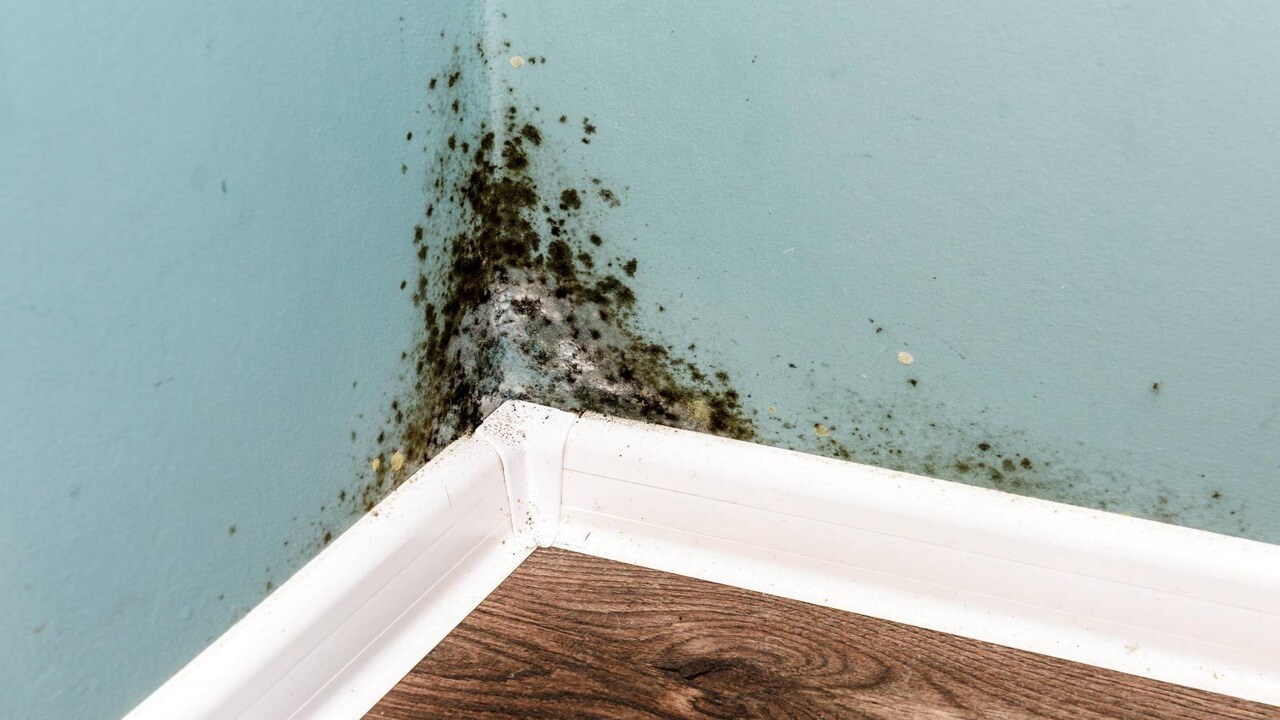
Mould spores are present everywhere in the air, indoors and outdoors. They only become a problem when they land on a surface where conditions allow them to grow. Two conditions must be present together for mould to take hold:
- Persistent humidity: The air near the surface must remain humid for extended periods. Mould does not need liquid water or visible condensation — damp air alone is enough.
- Cold surfaces: Walls, ceilings, or other surfaces that are colder than the surrounding air create a localised zone of higher humidity at the surface. Poor insulation, thermal bridging (for example at lintels or wall junctions), and unheated rooms all contribute to cold surfaces.
A common misunderstanding is that condensation causes mould. In fact, condensation and mould are both consequences of the same underlying conditions — too much moisture in the air and surfaces that are too cold. You will often see them together, but mould can grow without any visible condensation at all. If the humidity at a surface stays high enough for long enough, mould will grow regardless of whether water droplets are visible.
What Creates Mould Growth Conditions?
Mould growth conditions arise when there is too much moisture in the air relative to the temperature of the surfaces in your home. This can happen because of one or both of the following:
How much moisture does daily living produce?
- Cooking: up to 3 litres per day
- Showering or bathing: 0.6–1.2 litres per use
- Drying clothes indoors: 2–4 litres per load
- Breathing and sleeping: 1–2 litres per person per day
A household of five occupants can generate over 12 litres of moisture per day from normal daily activities alone.
What You Can Do
Preventing mould is about reducing the amount of moisture in your home and keeping surfaces warm. Neither one alone is always enough — both matter.
Managing Moisture
- Open windows when cooking, showering, or bathing. Windows are your primary source of ventilation. Extractor fans are there to assist them, not replace them (unless your home has a whole-house mechanical ventilation system such as MVHR).
- Use extractor fans in kitchens and bathrooms. Make sure they are working and venting to the outside, not into the loft or a wall cavity.
- Avoid drying clothes indoors wherever possible. If you must dry clothes inside, open windows in the room while doing so. Never dry clothes directly on radiators.
- If you use a tumble dryer, make sure it is either a condenser model or is properly vented to the outside. Open a window in the room while it is running.
- Keep lids on pans while cooking.
- Use a dehumidifier if moisture levels remain high despite ventilating.
- Try purge ventilation: open all windows and external doors at the same time for 10–15 minutes, ideally once in the morning and once in the evening. This exchanges the humid indoor air for drier outdoor air.
A common misunderstanding is that condensation causes mould. In fact, condensation and mould are both consequences of the same underlying conditions — too much moisture in the air and surfaces that are too cold. You will often see them together, but mould can grow without any visible condensation at all. If the humidity at a surface stays high enough for long enough, mould will grow regardless of whether water droplets are visible.
Keeping Surfaces Warm
- Keep your home at a consistent temperature between 18°C and 21°C. Avoid letting rooms go completely cold and then blasting the heating — steady, low-level background heat is more effective at keeping surfaces warm.
- Leave a gap of at least 50 mm (about two inches) between furniture and external walls. This allows air to circulate and prevents cold, still pockets of air from forming behind wardrobes, beds, and sofas.
- Keep internal doors open where possible to allow warm air to circulate throughout the property.
Reporting Defects — Your Responsibility
Many damp and mould problems are caused or made worse by building defects that allow water into the property. It is important that you report any of the following to us as soon as you notice them:
- Damaged or missing roof tiles or slates
- Blocked, overflowing, or damaged gutters and downpipes
- Cracked or damaged external render or pointing
- Leaking pipes, overflows, or cisterns
- Failed seals around baths, showers, sinks, or windows
- Any flooding or standing water, however minor
- Extractor fans that are not working or are noisy
- Any new damp patches, staining, or mould growth
Important: Do Not Use Bleach or Biocide Sprays on Mould
Further Information
For further advice on mould in the home, free guidance sheets are available from the UK Centre for Mould Safety at www.ukcms.org.